BREACHPOINT
Rounds are short. Standing still is accurate. Running is not.
Four modes, two maps, and one elderly dog who would rather stay where he is.
Two minutes,
four decisions
Every round runs the same clock. What changes is your wallet, your read on the lanes, and whether the charge is already ticking.
$800 opens the match. Spend it on a gun, a vest, a defuse kit — or save and win the next round instead. Losing streaks pay better.
Three lanes out of spawn — west, mid, east. Attackers commit; defenders listen. Footsteps are the only intel either side gets.
Stand on the pad at site A or B and hold. The moment the LED goes red the round resets to 45 seconds and the roles invert.
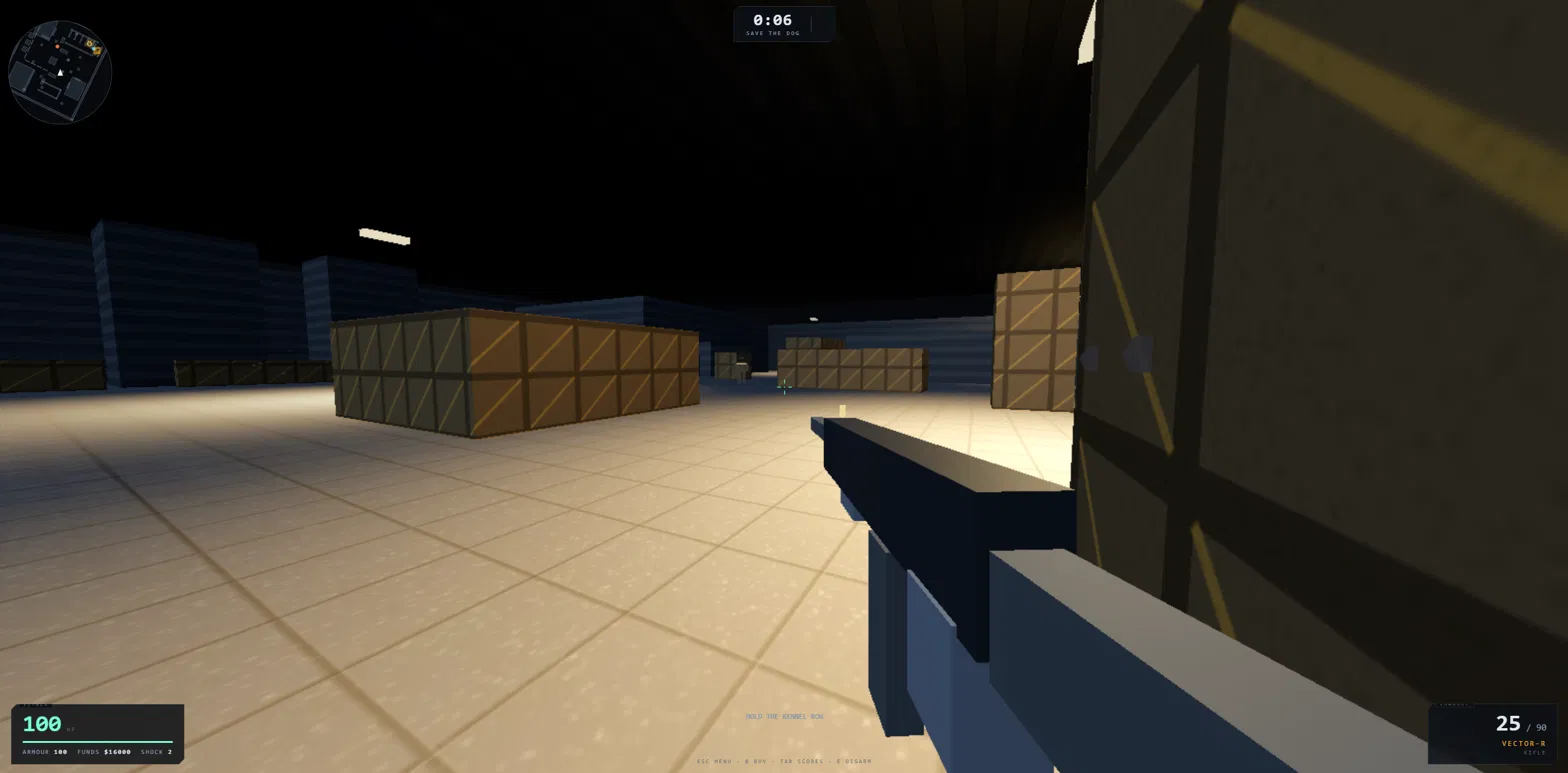
Six seconds bare-handed. Three and a half with a $400 kit. Either way somebody has to clear the site first — and stay cleared.
Four ways in
The full loop: buy phase, round economy, one life, plant and disarm. Bots scale their loadouts as the match goes long — pistols in round one, rifles and marksman kit by round five.
Five minutes, instant respawn, full loadout handed to everyone. No economy to protect and nothing to lose — just the substation at its loudest.
An abandoned sanctuary. One team takes the last animal left in it, one team keeps him. He does not want to go with either of you.
No clock, no pressure, targets that come back. Learn where each spray pattern climbs and where it starts to snake — the recoil is deterministic, so it can be memorised.
Seven guns,
no duplicates
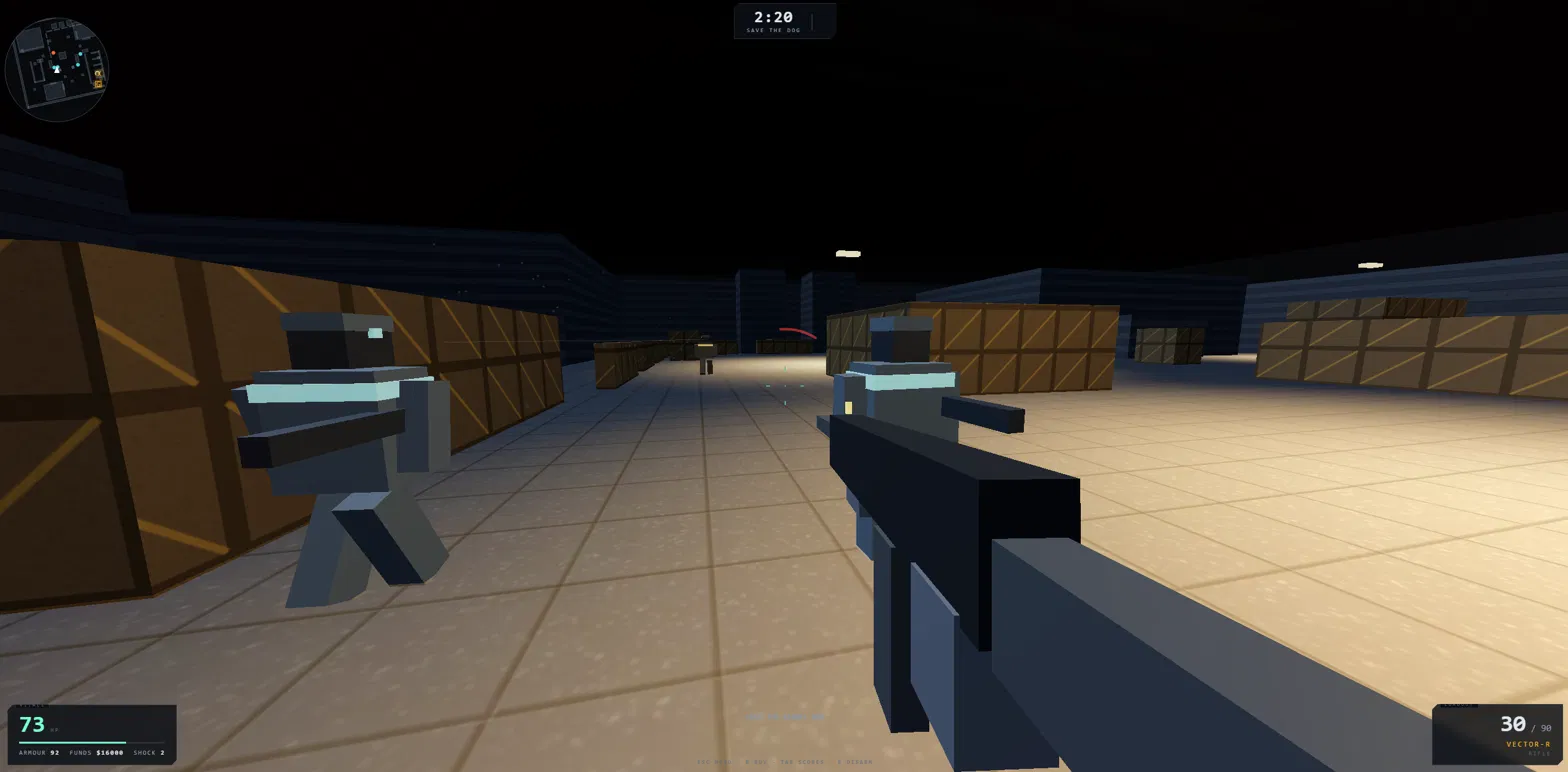
Every entry is priced against what it does to a vest. Penetration matters as much as damage: buckshot dies on plate, rifle rounds barely notice it.
Substation
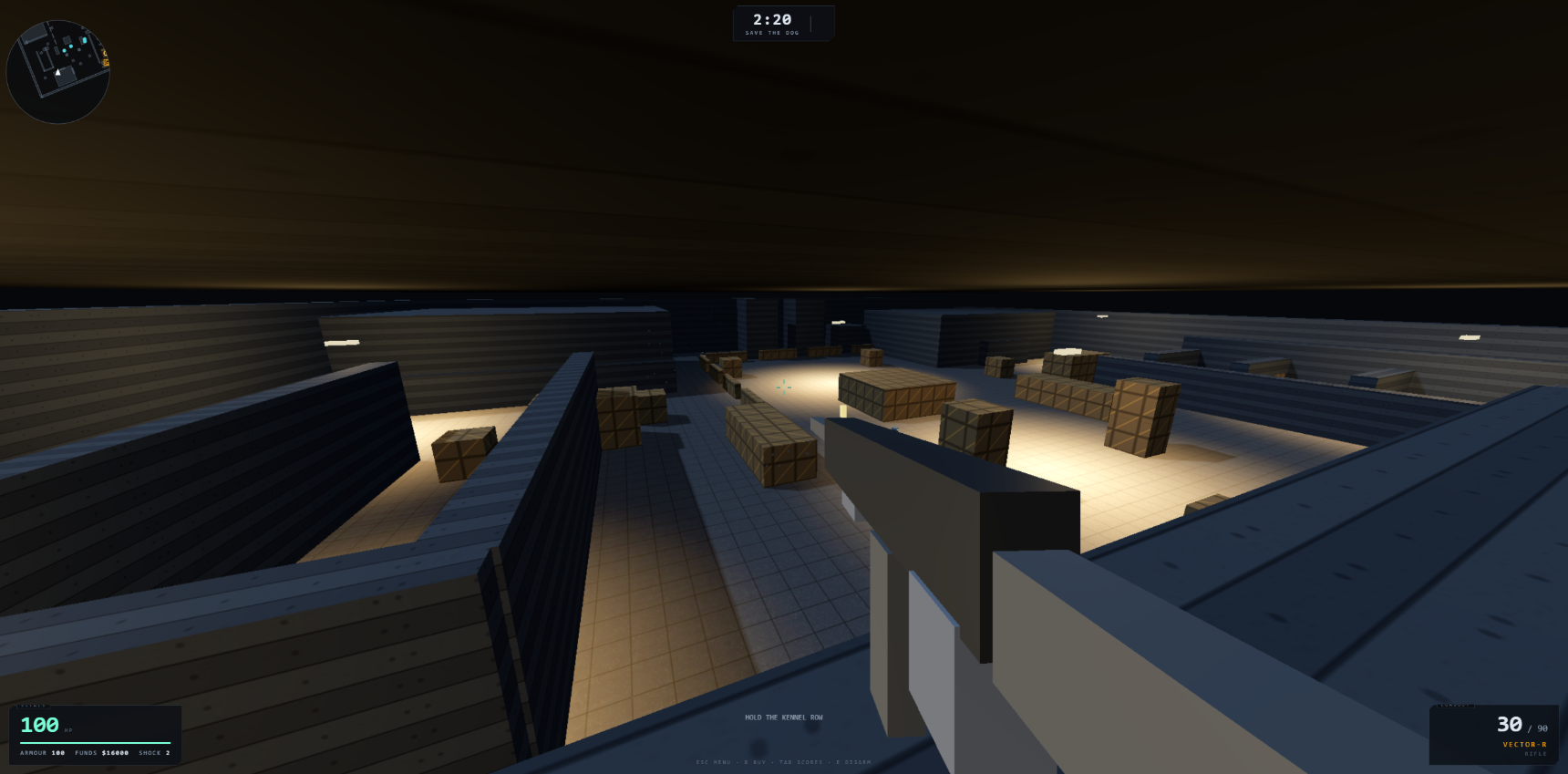
Two switchgear blocks split the north half into three lanes and nothing else. There is no third route, no vent, no shortcut — attackers pick west, mid or east and defenders get exactly one rotation to be wrong about it.
Both sites sit behind shoulders at either end of the courtyard, so a hold looks into the pad rather than standing on it. Crates stack two high at the pads: the only elevation on the map, and the first place a good defender checks.
Four things
that decide fights
Standing still is accurate. Running is not, and jumping is a coin flip. Stop, then shoot — in that order.
Every pattern climbs for the first four rounds, then snakes. Pull down and counter it, or tap and reset.
Vests soak pistol rounds and buckshot. Rifles punch through, and the .50 ignores the question entirely.
Footsteps carry 26 metres. Walking hides them. Most rounds are lost by the player who sprinted into a hold.
Your tab is
the server
Host a room, send the link, keep the tab open. Friends who open it drop into the next round and bots step aside to make space — no lobby, no matchmaking queue, no install on their end either.
Five-character room code if you would rather read it out loud than paste it.
No engine,
no asset store
The map is a list of boxes. The textures are drawn to a canvas at load. Every gunshot, footstep, ricochet and defuse beep is a filtered noise burst built on the fly — there is not a single audio file in the build. Five quality tiers, from ULTRA down to POTATO, and the build steps itself down if your frame rate says so.
The map, the weapon names and stats, the models, the interface and the audio are all original work. Breachpoint borrows the rules of the tactical-shooter genre, which are free for anyone to use. It copies no assets from any existing game.
Mouse capture blocked? Hold right mouse to look, or steer with the arrow keys.
The Albrehtson
Sanctuary
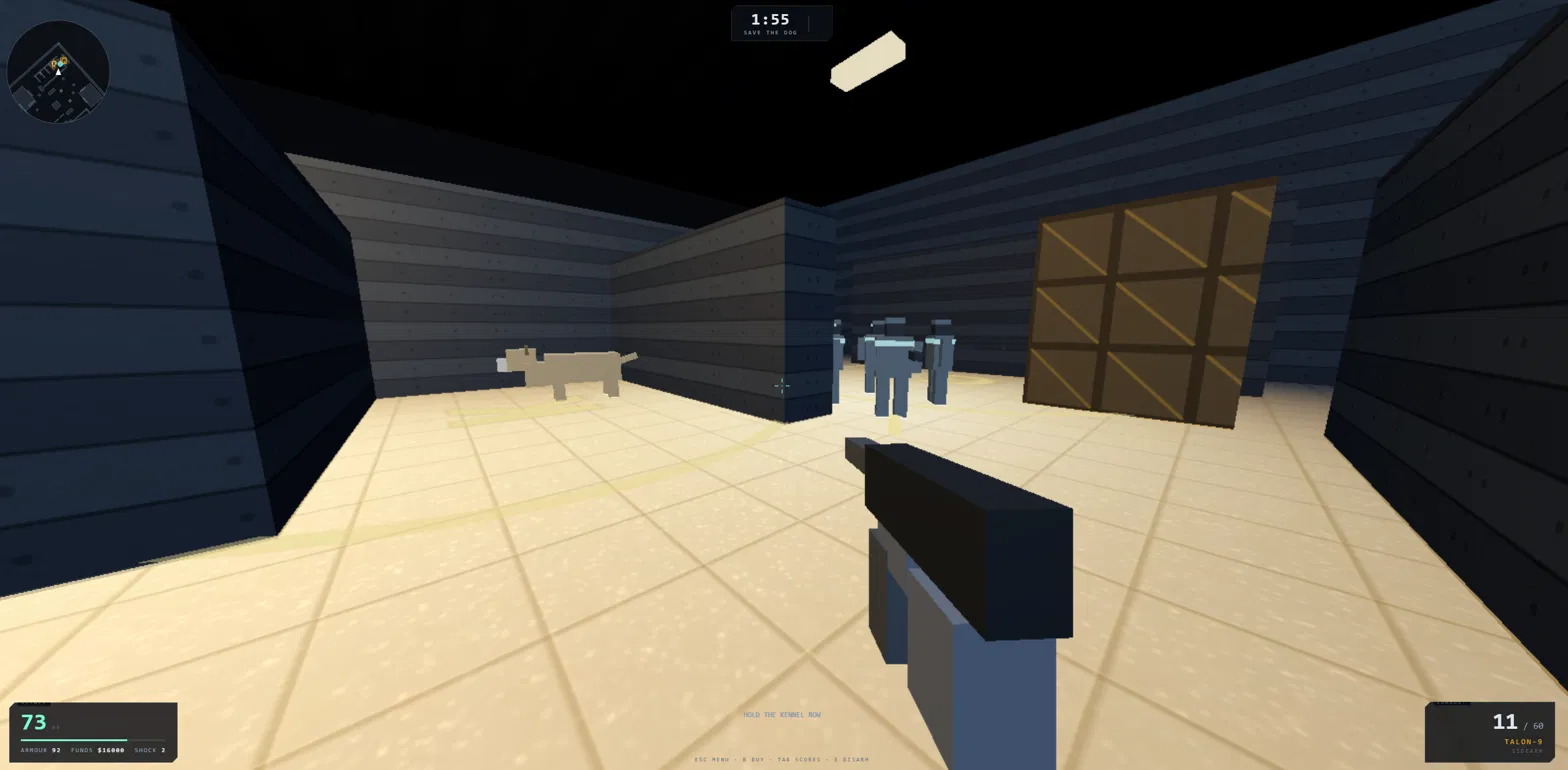
Second map, second objective: an elderly mastiff called Bram. Attackers get two and a half minutes to put a hand on him and walk him to the loading gate. The keepers get two and a half minutes to make sure that does not happen.
The last line in a book kept since 1769
The Albrehtsons bought livestock for ships. In 1769 one of them stopped recording animal deaths as a percentage and started recording them one line each, and every generation after inherited that change of unit.
The sanctuary they left behind was never destroyed. Nothing was burned or torn down. Every building on that ground was made with real care to hold a living thing comfortably — and then the living things stopped arriving, and the buildings went on standing in the shape of a kindness nobody performs any more.
The water trough is dry, and it is spotless. Someone scrubbed it. Then never filled it again.
He is not a bomb with fur. Left to himself he circles the run he was raised in. Gunfire inside twenty-six metres frightens him, and a frightened dog drops his tail, slows down and stays closer to home — so the team shooting its way in is also the team making the job harder.
Getting hold of him is a hold-to-act, like a defuse. Attackers need four and a half seconds. Keepers need two and a half, because he knows them. Either side can take him back off the other in three, which is how most of these end: a tug of war in a corridor with the clock running.
Walk more than twenty metres ahead of him and he stops following. He is old, and he moves at a fraction of your pace, and he has no interest in either team's plan.
SILOS
Him, on a leash, within four and a half metres of the loading gate.
The clock reaches zero with him anywhere but the gate.
Every attacker eliminated. Nobody left to walk him anywhere.
Every keeper down, and none of them holding him when they fell.
Hold the
substation
One tab, two maps, eight rounds to win — or two and a half minutes to get one very reluctant dog through a gate. It loads faster than the launcher you were going to open instead.
PLAY BREACHPOINT